Why Honduras?
A brief contextualization of a massive scandal

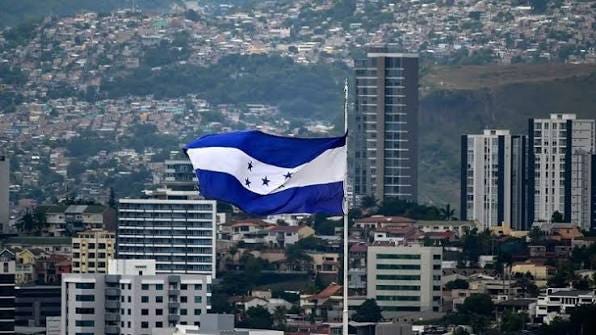
With the massive audio leak known as Hondurasgate coming into the public eye earlier this year, the previously unknown extent of the Honduran government’s connection to global Zionism is now much clearer. Though there is likely a lot more that will be revealed in the future, what we have learned about this already builds upon much that we have previously known about Honduras’ geopolitical importance, especially as related to Juan Orlando Hernández (JOH) and Nasry Asfura.
This article seeks to elucidate the context behind the very existence of the Hondurasgate tapes in the first place. It will be an analysis of the myriad geopolitical factors that have led to this moment where Honduras is at the focal point of a massive, US-Israeli conspiracy to solidify their economic and political hegemony in the region. We will come to understand Honduras’ specific importance in this endeavor through both historical study and the current political matrices at play, in which cocaine smuggling, hasbara, counter-insurgency operations, surveillance and AI are all at play.
The US
Despite its small size and population, for at least a century Honduras has been incredibly important for US economic and geopolitical concerns. The nation lies near the geographic center of the Central American region and has access to both the Atlantic (via the Caribbean Sea) and the Pacific oceans. Its coastal alluvial plains fed by the mountainous interior provide rich soil for agriculture, and the mountains themselves, along with the many dry and wet forests, have been used for the large-scale extraction of lumber and the heavy metals. As the use of Honduras by the US as a military outpost flows from its initial status as an economic neo-colony, we must necessarily start there, with resources and the potential for exploitation.
Influenced by its rich, agricultural soils, Honduras has a long history as a US “banana republic”, a nation essentially under complete control of the interests of US fruit companies. Referred to as the “original banana republic” much of Honduras’ land was bought up by US companies such the United Fruit Company (now “Chiquita”), Standard Fruit and Cuyamel Fruit Company beginning in the late 19th century. Within decades, almost all Honduras financial, governmental and economic institutions were the control of these companies, and by proxy, the US state, therefore most of the country sank in deepening poverty exasperated by comprador oligarchs and infrastructure almost solely for the production and shipping of fruits. The successor companies of Chiquita and Dole continue to exercise massive amounts of influence over Honduras’ economy primarily via banana production and exporting to this day.
It did not take long for the US military to increase its presence in Honduras, an effort that began in the early 1900s. Seven different deployments of the American military landed in Honduras to protect the interest of banana corporations between 1903 and 1925, including a 1912 coup which included banana corporation mercenaries (a topic we will explore more in an upcoming section where it is more specifically relevant). From that point, Honduras became a permanent base for other US military interventions in the areas. One of the biggest steps in securing this status was the establishment of the Palmerola Air Base in Comayagua in 1940, which over the next few decades became the US’ largest base in Central America, taking the name “Soto Cano”. This military infrastructure and the presence of US personnel served to provide military training to Honduras’ military so as to effectively participate in and assist future military interventions.
This would soon pay off with the 1954 CIA coup against Guatemalan president Jacobo Árbenz and his implementations of land reforms at the expense of the United Fruit Company. In May of that year, one month before the coup, the US and Honduras signed a bilateral military assistance agreement that would be expanded upon in the following decades. This enabled the further coordination of arms shipments to US-trained Honduras anti-Árbenz fighters, who would make marked armed incursions into Guatemala that year with the assistance of air bases in both Honduras and Nicaragua that provided bombers. The success of this coup and a consistently pliant government in Honduras would only increase its geo-political importance to the US for coups and reactionary counter-insurgencies. Honduras gave the US an increased geographical reach for its interventions in terms of logistics. One of the most definitive attempts of imperialism linked to Honduras during this period was the 1961 failed Bay of Pigs invasion against Cuba in which the Honduran Swan Islands were used as both a CIA training ground and weapons trafficking point for anti-Castro insurgents. Increased, consistent military exercises between Honduras and the US began in earnest in 1965, the same year in which different US Task Forces would rotate in and out of Soto Cano Air base. The fourth of these groups, Joint Task Force Bravo(JTF-B), would be deployed in 1982 (at first as “Alpha”), corresponding with the full, modern establishment of the Soto Cano Air Base as the fully US-operated SOUTHCOM air force hub. Bravo still remains the primary military force at Soto Cano Air Base due to the specific conditions that first created them in the 80’s, with their extended presence past 1982 due the US’s imperial need for a
“Central American regional training center in Honduras, from which the United States would train military and paramilitary forces from Honduras, El Salvador, Guatemala, Panama, and Costa Rica, and the conduct of a multinational exercise, Big Pine II, which was focused on Sandinista activities in Nicaragua.”
Indeed, it was Sandinista victory in 1979 that most prompted this, as well both the socialist Farabundo Martí National Liberation Front (FMLN) from El Salvador and the Cinchoneros, another revolutionary socialist guerilla group domestic to Honduras itself. Big Pine II was the first of several military/intelligence operations coordinated between 1983 to past the “official” end of the Contra War in 1990 where a rotating door of at least 10,000 US troops (prominently including JTF-B) and CIA actors collaborated with the Honduran military to train the Contra insurgents for operations against not only the Nicaraguan Sandinistas, but the FMLN and Cinchoneros. Though the US army and media washed these actions to the public as a measure to “contain” the Sandinistas to Nicaragua1 they effectively turned Honduras into a massive base for the Contras and their US-trainers.
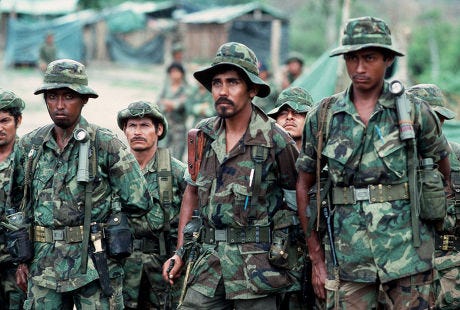
Between 1984 and 1990 (corresponding to the overlap of the “end” of the Contra War, and the military decline of the Cinchoneros and FMLN) the US poured at least a total of $432.7 million into Honduras so that JTF-B could continue conducting exercises for the Honduran military, as well training and funneling funds to the Contras and Salvadorean death squads. Despite claims that JTF-B “decided that military force would not be the answer to the insurgency problem” and other related claims in the previous source, School of the America’s graduate and Honduran general Gustavo Álvarez, with money and training to the Honduran army provided by both the US army and the CIA, went on massive repression campaigns where death squads “disappeared” at least hundreds of people suspected of being fighters/sympathizers of either the Sandinistas or Cincheros until 1984. The repression of Álvarez was part of a rightward trajectory in which the Honduran army, encouraged by their government’s alignment with the US in counter-insurgency measures, sought to destroy all perceived leftist threats to them and the US. The torture tactics used by Álvarez and his ilk are well known for being taught at the School of the Americas to future US-alignment civic and military authorities in Latin America. Álvarez’ associate Florencio Caballero specifically acknowledged both the CIA’s lack of hindering human rights violations as well as their role in employing professional torturers from the US-backed Argentine military government to assist the Hondurans. “The Americans knew everything.” Not a protest from JTF-B nor the US government. “They did not do anything” Caballero also stated. The money, training and joint exercises continued for years.
The only pause in US support to all these aforementioned reactionary forces, but specifically relating to the Contras, came with the series of Boland Amendments which cut off official military funding to the Contras beginning in 1982. In order to continue clandestine activities against Nicaragua and the FMLN, The CIA assisted the Contras in drug trafficking operations to the US, which generated funds for their continued armed operations. This, along with arm sales to Iran which generated more funds to be laundered into military and logistical assistance, comprised the Iran-Contra scandal and it effectively bypassed the Boland amendments. It connect the Contras to a vast CIA-affiliated network, including but not limited to the Medellín Cartel, Panamanian dictator Manuel Noriega and Honduras’ air-based logistics system; an entire international laundering operation funding the Contra’s war crimes that caused the US to first run cover with the Boland Amendments in the first place. Honduras, with its air infrastructure and massive presence of Contra bases, was vital to this effort. Weapons both meant for them and Honduran military were facilitated through JTF-B at Palmerola after first being smuggled in via a CIA base in the Swan Islands. Through all this, not only will Honduras’ political and military utility to the US be solidified, but the infrastructure and organizational capacity for drug smuggling be established.
(The following section pulls largely from the Honduras section of my previous piece “Surveillance and the Network Hemisphere. All specific sources for claims common between these pieces can be found in “Surveillance”. Any claims that are not differently cited come from either from the original analysis or sources cited in the aforementioned work.)
The consequences of the 2009 US-backed coup in Honduras revitalized and strengthened institutional cocaine trafficking. The eventual ascent of Juan Orlando Hernández to the presidency saw the whole use the Honduran state infrastructure to secure his personal profit from said trafficking. Hernández utilized the police especially to smuggle drugs and to protect personal narcos associated with him, by which he attained more funds for political campaigns. He also selectively extradited rival drug traffickers to the US to both monopolize the drug trade under him and curry favor with his imperial supporters. For years, the US intelligence and military presence in Honduras paid little mind to Hernández’ activities given his alignment to the US instead of the previous leftist president, Manuel Zelaya. Supported by both Obama and Trump (during his first term), Hernández was only convicted when he accepted a $1 million bribe from former Sinaloa Cartel leader “El Chapo” and when his brother, Tony, was caught smuggling cocaine in Miami. Even then, his conviction and extradition only came at the end of his second term in 2022.
Hernández used the panic of the drug trade in order to manufacture a state of exception that allowed Honduras’ government to build a massive surveillance apparatus, one also helped him to secretly solidify his slice of the narco pie. He boosted former president (and coup-participant) Porfirio Lobo’s 2012 Wiretapping Law with AI technology from Palantir and from Israel’s Cellebrite to further crackdown on dissidents and rival drug traffickers. As he consolidated power with the tacit consent of the US, the “Special Economic Zones”(Spanish acronym “ZDE” Zona de Empleo y Desarrollo Económico) that enabled that expansion of large “start-up cities” such as Próspera, essentially a “tax-free, crypto and AI-fueled playground for rich techno-fetishists”, a Thiel-linked venture that began the US’ ambitions to surveil all of Latin America through both compliant surveillance regimes and unaccountable extraction and development zones for foreign capital: a “network state/hemisphere”.
Despite its supposed opposition to drug trafficking, JTF-B and the greater US military ignored every instance of abuse and corruption. Hernández was (and with Trump’s second-term pardon, is) their guy. He and his current president/National Party comrade, Nasry Asfura (who came into the presidency after US meddling), have the complete support of the US government due to their continued subordination to US military and economic designs. Unlike the Manuel Zelaya/Xiomara Castro led opposition, and a good portion of Hondurans, Hernández and Asfura have no intentions of closing the largest US military base in Central America. Time will tell if the US deems Hernández’ desire to succeed Asfura as puppet-in-chief necessary to expand Yanqui economic and military control and maintain a fake news propaganda war against any existing left-wing government in the region, setting the stage for future coups and repression.
Israel
The relationship between Israel and Honduras goes back decades, having been intertwined principally with US imperialism in the nation. This section will look at events overlapping with US actions and those not already elaborated upon in chronological order, starting from the rule of banana companies to Hondurasgate. Special attention will also be paid to their role together with Hernández and Asfura, drawing again from a previous article of mine to some extent.
One of the most decisive actions in solidifying Honduras’ subservience to US economic interests occurred as one of the many early 20th interventions in the nation. In 1910, president Miguel Dávila attempted to renegotiate its sovereign debt and curb the influence of bribes paid by Cuyamel Fruit Company. This earned the ire of its founder, Samuel Zemurray, a Zionist Jew. That year, Zemurray organized a troupe of mercenaries to force exiled former president Manuel Bonilla back into his old position and rolled back any reforms hostile to Cuyamel; this included a further concession of over 24,000 acres.
Zemurray, with his Honduran and US government connections, would also use this influence to help coup Árbenz from Guatemala for expropriating thousands of acres from United Fruit, which was also owned by that point. Many of his profits went towards facilitating the founding of Israel through both violent and diplomatic means. He was known to have financially supported the Jewish terrorist organization Irgun, which would later be an establishing organization of the IDF, by sending them arms with which they killed and expelled Palestinians before and during the Nakba. According to biographer Rich Cohen, Zemurray’s power in Central America even held to lead to the passing of UN Resolution 181, which established Israel as cleaved away from the former Mandatory Palestine,
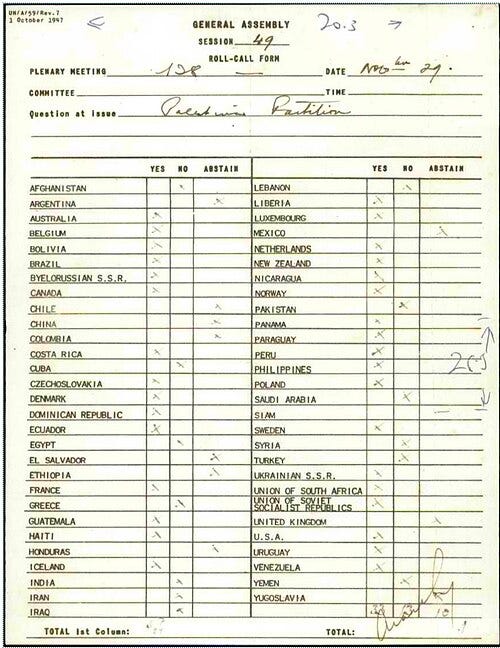
We can see this specifically in the “yes” votes from Guatemala and Costa Rica above (Honduras abstained), though this abstention could have easily been a “no” vote. The National Party as founded by Manuel Bonilla, the comprador president re-installed by Zemurray in 1910, was still in power during the 1947 vote. As we will see later, though US/Israeli collaboration is not limited to the National Party, they will continue to intensify their connections especially with the ascension of Hernández. This specific connection has its genealogy here.
Israel’s connection to Honduras and the US-sponsored anti-revolutionary campaigns there really ramped up in the 1980s. Israel made massive arm sales and associated in training efforts to both the Contras as well as El Salvadoran and Guatemalan death squads (a major contributor the Mayan Genocide which the Guatemalan state perpetrated with Israelis assistance), the former two largely using Honduras as their base. At many points, they even took greater material roles in the region than the US themselves. American sources in Honduras during the time remarked that
“Israel operates without the restrictions imposed on us in this part of the world. It doesn’t have to explore the abuse of human rights. It has arms to sell and the governments of this region need them.”
Contra groups themselves boasted about receiving thousands of weapons from Israel, who would come to provide them over ¼ of their total arms capacity - and before even arming (overwhelmingly with Galils and Uzis) and training the Contras, Israel also provided over 83% of the arms El Salvador’s military, police and death squads (including napalm used against rural people) between 1973 and 1980 - Israeli advisors would also go on to train them in torture methods throughout the 80s (ibid.). Israel provided Honduras itself with dozens of hypersonic bombers “the first in Central America”, transport planes, jets, armored cars, small arms and many more types of military equipment leading up to the 80s. These would be used both against the Nicaraguan and Salvadorean communist forces as well as those domestics to Honduras, both via direct training and the usage of Honduran infrastructure. Previously mentioned death squad leader Gustavo Álvarez specifically visited Israel in 1982, the inaugural year of full, modern Soto Cano/Palmerola Air base, “in search of alternatives to US warplanes in case Congress refused to sell them”. Israel’s air force and defense ministry happily obliged him. They sent Israeli jets that would have been stationed at Soto Cano as well as tanks, small arms and personnel, not only military trainers for Honduran death squads but Israeli pilots and troops to fight with them. As elaborated pages and paragraphs before, we have seen how this has contributed to the massively fatal consequences for people and militants across the region during this time.
Financial gain was not the only motive for Israel during this time; it was a chance to continue solidifying ties with the US by assisting in their own local, more local geo-political goals as the US has assisted Israel in theirs. Though this is speculation, these may have also been moves to recover more favor with the Reagan administration after his 1982 threats to cut-off financial assistance to Israel after their massive, civilian-targeting bombing campaigns and incursions into Lebanon. Luckily for us, Israel, allies of the former Somoza government, itself cited “anti-semticism” by the Sandinistas as a justification for their activities throughout the region. This claim, bolstered by the Anti-Defamation League and the Reagan administration, was rebuffed by the Nicaraguan Jewish community itself.
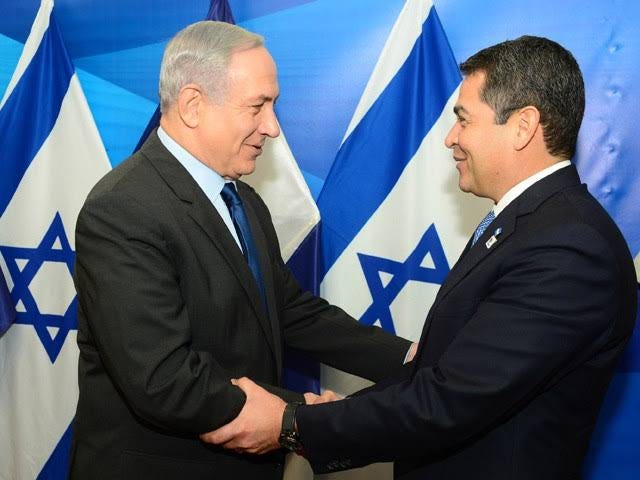
Israel would go on to have normal relations with Honduras since, with this relationship accelerating to the point it is at today through the different actions of the National Party throughout the 21st century. The government of Porfirio Lobo emphasized, after succeeding Roberto Micheletti (the brief, post-coup interim president). that Honduras “aspires to maintain good diplomatic, cooperation and market relations with Israel.” As touched on earlier, the following Hernández government would go on to further strengthen this relationship. In addition to using Israel surveillance tech, like Pegasus, Cellebrite and Circle, to spy on dissenting forces, Hernández would not only massively ramp up Israeli arms sales since their peak in the 80s, but he also invited about 1,000 IDF troops to station in Soto Cano air base with the US military. This first ever time Israel has had a permanent military presence abroad was ostensibly to help with “border protection” but was truly part of the process of moving the Honduran-Israeli embassy to Jerusalem. The former source also explains the relevance to a $1 million arms purchase from Israel validated around the same time. Any involvement of the DF in Hernández’ drugs schemes and targeted persecutions is at the time unknown.
Hernádez’ successor Asfura has described himself a Zionist and has every intention of continuing Honduras’ ties with Israel, which also stretch to patronage of Palantir and the expansion of ZDE (such as the infamous Próspera) that are linked to several Zionist capitalists such as Peter Thiel, Marc Andreeson, Sam Altman and others. As someone who largely owes his election success to interference from the US Zionist government (ibid.), Asfura continues to support the US’s hegemony and the expansion of their imperialist drive to turn the entire region to the right. His name is mentioned countless times in the Hondurasgate recording as a party to restore Hernández to power and sell off Honduras to tech billionaires, General Electric and the US and Israeli militaries/intelligence systems. One specific recording mentions “moving another Palmerola” to Roatán, the site of Próspera, and trading specifically with the US and Argentina in order to cut out China.
The reactionary governments of Honduras have for decades been able to carve out their own functional niche in the US imperialism; it now figures stronger than ever in different economic and military matrices that stretch not just across Latin America, but to West Asia, if not further. We see through the different leaked recordings just how vital it has become. The US cannot give it up. It is a site of investment not only of US and Israeli military/spy tech/infrastructure, but off massive, continent-spanning surveillance and disinformation systems. All of this has germinated from its conversion of the country by several generations of opportunists and fascists into a Banana Republic and a 112,000 square kilometer military base. This is why Honduras has emerged in this such way - it was a minnow elevated into a bastard, half-formed shark, but one that can never swim on its own, relegating to biting and lashing out even as it’s made to starve on the crumbs and chum of what it helps to destroy. It is clear now that any challenge to US/Israeli power must reckon with their removal from Honduras.
Especially relevant is that this washing was part of the justification of 1988’s “Operation Golden Pheasant” where the US used Palmerola Air Base to bomb Sandinistas counter-attacking Contra bases in Honduras
Thank you for this piece, translated in French here : https://zanzibar.substack.com/p/pourquoi-le-honduras-breve-mise-en
Israel conquering Latin America is very cool but what do they hope to gain from it, Brazilians or Mexicans aren't Americans as USA they don't fight other than the fact that they are poorer etc